





 Coffee is ideal for stirring up philosophy and even emotions. And a cup under a tree, after boiling the water on that rustic stove made of three stones and firewood. Arelis owned the strainer and even the family coffee plantation that makes the miraculous substance possible on a December morning. And it was the sip, the first sip, and that delicious taste couldn't be missed, while María Méndez celebrated the christened Yeguili, which brought us to Las Guásimas, and which has new tires to return many times.
It's the group that was born at the beginning of the 21st century next to the Rioja River, at the Mir crossroads on December 23, 2001, in the home of the siblings Daysí and Ramón Acosta. It's the group that today, twenty-four years later, the UNEAC (National Union of Writers and Artists of Cuba), Radio Juvenil (Youth Radio), and the Salas television program have created as a fraternal space where poetry, music, traditions, and legends, along with popular philosophy, form an intimate and fraternal celebration of Cuban identity.
 [The Cabaniguán Gathering has become a meeting place for cultural traditions.] The Cabaniguán Gathering has become a meeting place for cultural traditions.
With the last sip, Martha Velázquez glanced at the pot of ajiaco and affirmed that her yucca was creamy, but her pride lay in her granddaughter Isis Daimí, who recited her verses to Fidel, just as she had done 130 years earlier in Mala Noche, during the farewell to the invading column, the unforgettable Consuelo Álvarez, before the towering Antonio Maceo.
 [Young Isis Daimí dedicates her verses to Fidel.] Young Isis Daimí dedicates her verses to Fidel.
Isis, with her blue eyes, embodies the poetry that Cabaniguán, the bard of San Agustín, also knew how to write and be pure air. Poetry is eternity. And Isis's verses dedicated to Fidel's centennial are the grateful voice of a young woman with light eyes, gazing beyond the boundaries between life and death. She reaches the horizon, the very essence of the hero's presence.
For María Méndez, returning to each gathering is like opening all the windows of the house of time. Because conversing, philosophizing, is a civic act of connection without needing to access another dimension of existence.
[Daer Pozo Ramírez, leader of the Cabaniguán project, shares the conversation with residents of Las Guásimas.] Daer Pozo Ramírez, leader of the Cabaniguán project, shares the conversation with residents of Las Guásimas.
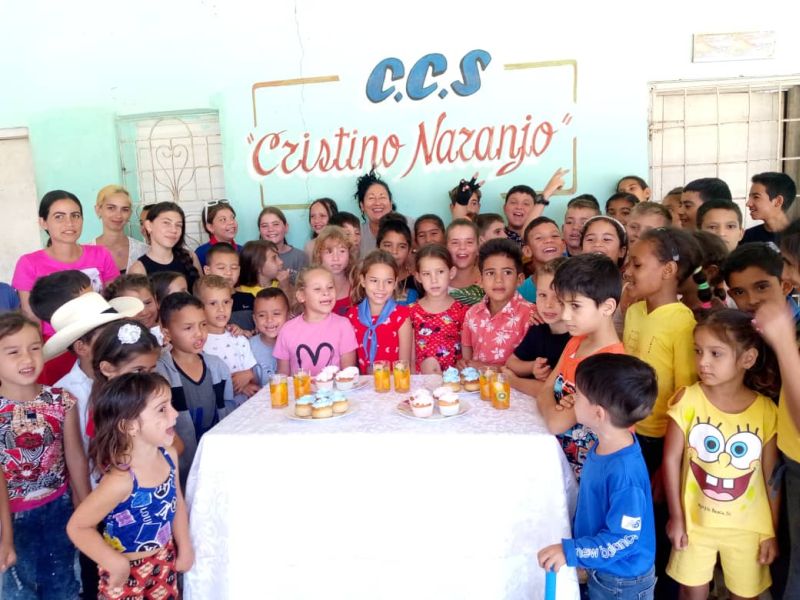
For Arelis Martínez, coordinator of the television room in Las Guásimas, the gathering represents unity among neighbors, generations, and above all, the opportunity for children and young people to engage in dialogue with creators and artists who reveal another dimension of words and deeds.
For Blanca Rosa Ramírez, coordinator of the La Chambelona gathering, the peña (a traditional gathering) is another opportunity for young people to learn about history. It was beautiful to hear about Fidel Castro's defense of humanizing the work of the porters when the Commander-in-Chief saw Felipe Brizuela sweating that August afternoon at the inauguration of the Las Ruinas restaurant in Lenin Park.
A coffee at the Cabaniguán de la Rioja peña is a way to enliven the community's spaces of inspiration and respite. And then there was the ajiaco (a traditional Colombian stew). It was delicious to toast with ajiaco to a happy 2026.